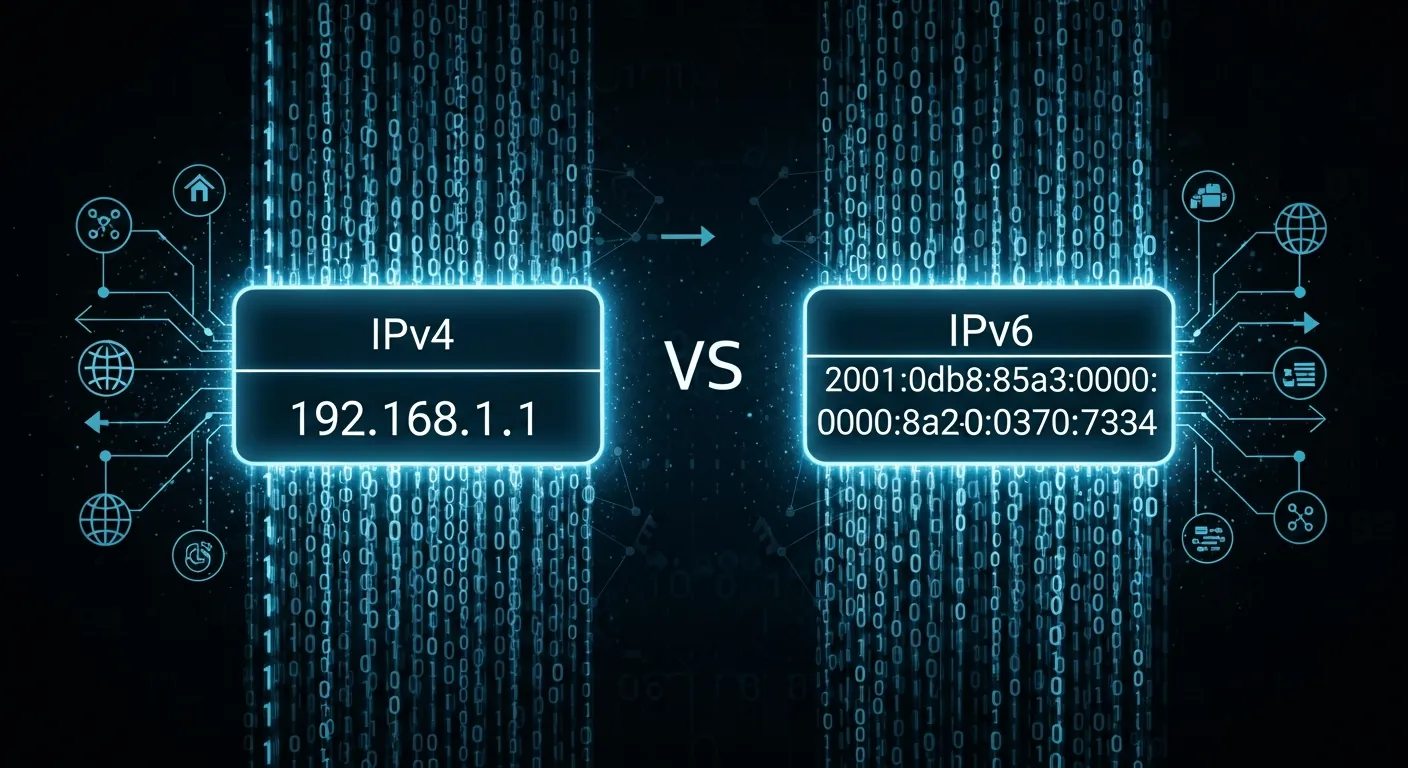
The internet is transitioning from IPv4 to IPv6. But what does this mean, and why does it matter? Let's explore the differences between these two protocols.
The IPv4 Address Shortage
IPv4 was created in 1983 and uses 32-bit addresses, allowing for approximately 4.3 billion unique addresses. At the time, this seemed like more than enough. However, with billions of devices now connected to the internet (smartphones, laptops, smart home devices, etc.), we've nearly exhausted all available IPv4 addresses.
Understanding IPv4
IPv4 addresses consist of four numbers (0-255) separated by periods:
- Example: 192.168.1.1
- Format: X.X.X.X where X is 0-255
- Total addresses: ~4.3 billion
Understanding IPv6
IPv6 was developed to solve the address shortage. It uses 128-bit addresses, providing an almost unlimited number of unique addresses:
- Example: 2001:0db8:85a3:0000:0000:8a2e:0370:7334
- Format: Eight groups of four hexadecimal digits
- Total addresses: 340 undecillion (340 followed by 36 zeros)
Key Differences
| Feature | IPv4 | IPv6 |
|---|---|---|
| Address length | 32 bits | 128 bits |
| Address format | Decimal (192.168.1.1) | Hexadecimal (2001:db8::1) |
| Total addresses | ~4.3 billion | ~340 undecillion |
| Security | Optional (IPsec) | Built-in (IPsec mandatory) |
| Header size | 20-60 bytes | 40 bytes (fixed) |
Benefits of IPv6
- More addresses - Enough for every device on Earth and beyond
- Better security - IPsec encryption is built-in
- Faster routing - Simplified header format improves performance
- No NAT required - Each device can have its own public address
- Better for mobile - Improved support for mobile networks
The Transition
Both IPv4 and IPv6 are currently in use. Most websites and services support both protocols. Your ISP may provide you with an IPv4 address, an IPv6 address, or both. The transition to IPv6-only is gradual and ongoing.